


The word behind the concept
The term "harem" comes from the Arabic harim, meaning a forbidden or private space. It referred, in its original Ottoman context, to the separate household quarters where women and sometimes favoured male attendants lived apart from the public world. The word carried legal and spatial meaning before it carried a sexual one. That distinction matters when you start looking at how it applies to all-male arrangements.
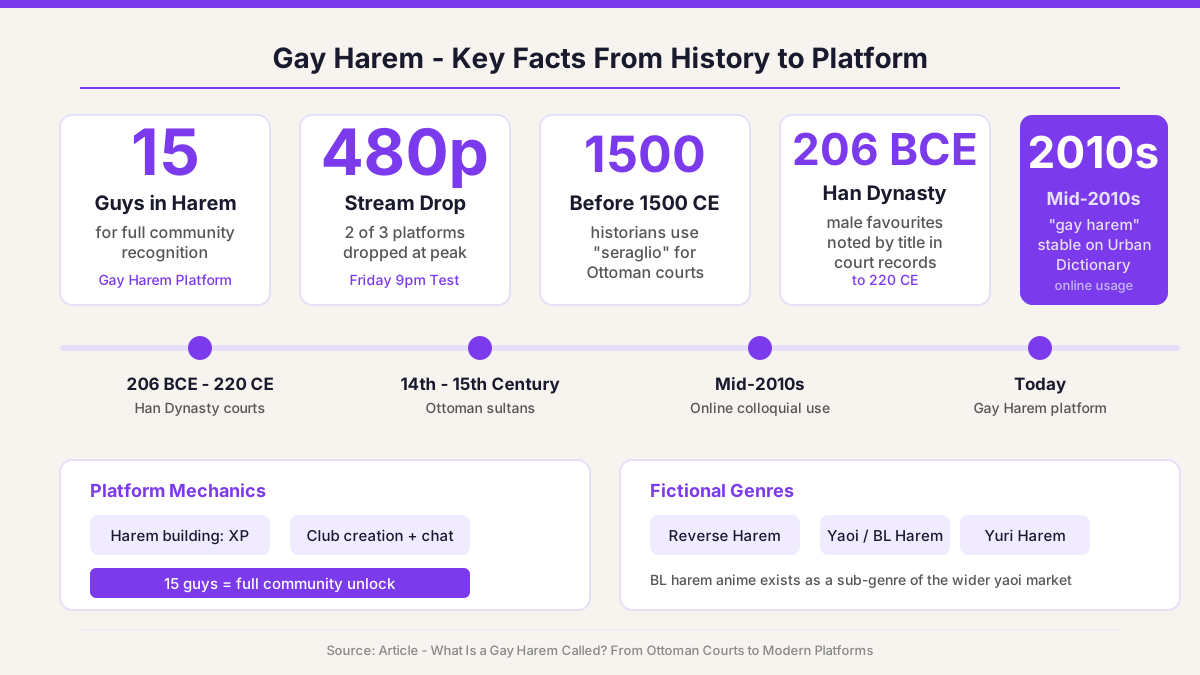
There is no single universally accepted English word for a gay harem. The closest historical equivalent is "seraglio," derived from the Italian rendering of the Turkish saray - meaning palace. A seraglio could include pages, eunuchs, and male favourites of a sultan, which is why historians writing about Ottoman homosexuality in the period before 1500 frequently use the term. It is more precise than "harem" for describing an all-male private court, and it avoids conflating the space with a female-only household.
Male harems in historical record
Ottoman sultans of the 14th and 15th centuries maintained relationships with male pages and favourites documented in contemporary chronicles. These arrangements were not anonymous: figures like Ibrahim Pasha under Suleiman the Magnificent appear in formal records. The word "harem" was not applied to these relationships in primary sources - that framing is largely a later Western imposition. What actually happened was a court hierarchy in which male proximity to the sultan carried both political and intimate weight.

In ancient Persian and Chinese imperial courts, similar all-male spaces existed with different local names. In Persian, the term andarun described inner household quarters that could include male attendants. In Chinese court records from the Han dynasty (206 BCE to 220 CE), male favourites were noted by title rather than any equivalent of "harem." The mechanics of these arrangements were administrative as much as romantic - position within the household determined rank, access, and safety.
The point here is factual: no historical culture produced a term that directly translates as "gay harem" in the modern sense. Historians use approximations, and so does everyone else.
Reverse harem, yaoi harem, and fictional genres
In anime and manga, the genre label "reverse harem" describes a story where one central character - often but not always female - is surrounded by multiple male love interests. When that central character is male and the love interests are also male, the genre sits under the broader "yaoi" or "boys' love" (BL) category. The specific tag used on catalogue sites is "yaoi harem" or "BL harem." If you want to explore whether there are BL harem animes, the genre does exist, though it is a smaller slice of the wider yaoi market.
Urban Dictionary entries for "gay harem" pull in both the fictional genre meaning and a colloquial social meaning: a gay man with a close circle of male admirers or partners. That informal usage has been stable on the platform since at least the mid-2010s. Neither definition is authoritative, but both reflect actual usage patterns in English-speaking communities online.
The word "yuri harem" follows the same logic for female-centred stories, which answers the related search cleanly: a yuri harem is a fictional arrangement where one female character is surrounded by multiple female love interests.
How Gay Harem the platform uses the term
Gay Harem at gayharem.co.uk takes the concept literally and turns it into a gamified cam experience. The platform centres on building a personal harem of performers - not a passive browse, but an experience-based progression system. Full community recognition kicks in at 15 guys in your harem. That number is not arbitrary: it gates access to certain social features, including club creation and club chat, where members share experiences with other participants.
The mechanics of harem-building here work differently from a standard cam browse. You accumulate experience points by finding and adding performers, which means repeated engagement is baked into the structure. The club system extends this: joining or creating a club links your harem activity to a wider community, giving the isolation of private show watching a social frame. Whether that makes the gamification compelling or just a retention tool depends on what you want from a platform.
I stress-tested three cam platforms back to back from my flat in Manchester on a Friday night in March, around 9pm when traffic peaks. Two of the three dropped to 480p without warning, and the fine print on stream quality guarantees was either absent or buried several pages deep. Gay Harem's performance during peak hours is worth checking before you commit to any subscription or token purchase - the mechanics of bandwidth allocation at scale are rarely disclosed upfront, and the difference between a quiet Tuesday afternoon and a Friday evening can be significant. Problematic when a platform's appeal depends on live interaction.
For a fuller breakdown of what the platform actually offers, the Gay Harem review covers sign-up, features, and what the experience looks like once you have cleared the 15-guy threshold. If you want to know what specific tools the platform provides beyond harem-building, the Gay Harem features page goes into the club system and chat mechanics in detail.
What to call it - a practical summary
The answer to "what is a gay harem called" shifts depending on context. In historical writing, "seraglio" is the most accurate term for an all-male private court. In fictional genres, "yaoi harem" or "BL harem" are the standard tags. In casual English online usage, "gay harem" is used directly and understood without translation. On gamified cam platforms, the term is adopted wholesale as a product name and mechanic.
None of these usages conflicts with the others - they operate in separate registers. The confusion usually comes from mixing contexts: applying a fictional genre term to a historical situation, or assuming the platform definition maps onto the historical one. It does not. The platform took a culturally loaded word and assigned it a specific functional meaning. Worth knowing when you are deciding which definition applies to a search you are running or a piece of content you are reading.
If the anime angle is your entry point, there is a dedicated look at BL harem anime that maps the genre conventions and lists titles that actually qualify under the definition rather than ones that merely gesture at it.
Comments
No comments yet.
Leave a comment
Your email will not be shown. Comments are reviewed before they appear.