

Why BL Harem Anime Is Harder to Find Than You Think
The BL harem anime genre barely exists as a named category. That is not an opinion - it is a structural fact about how the industry segments content. Standard harem anime positions one protagonist surrounded by multiple romantic candidates. BL (boys-love) does the same, but with a male protagonist and male suitors. The problem is that BL as a commercial category was built primarily for a female readership, and publishers have historically funnelled that energy into manga and light novels rather than anime adaptations.
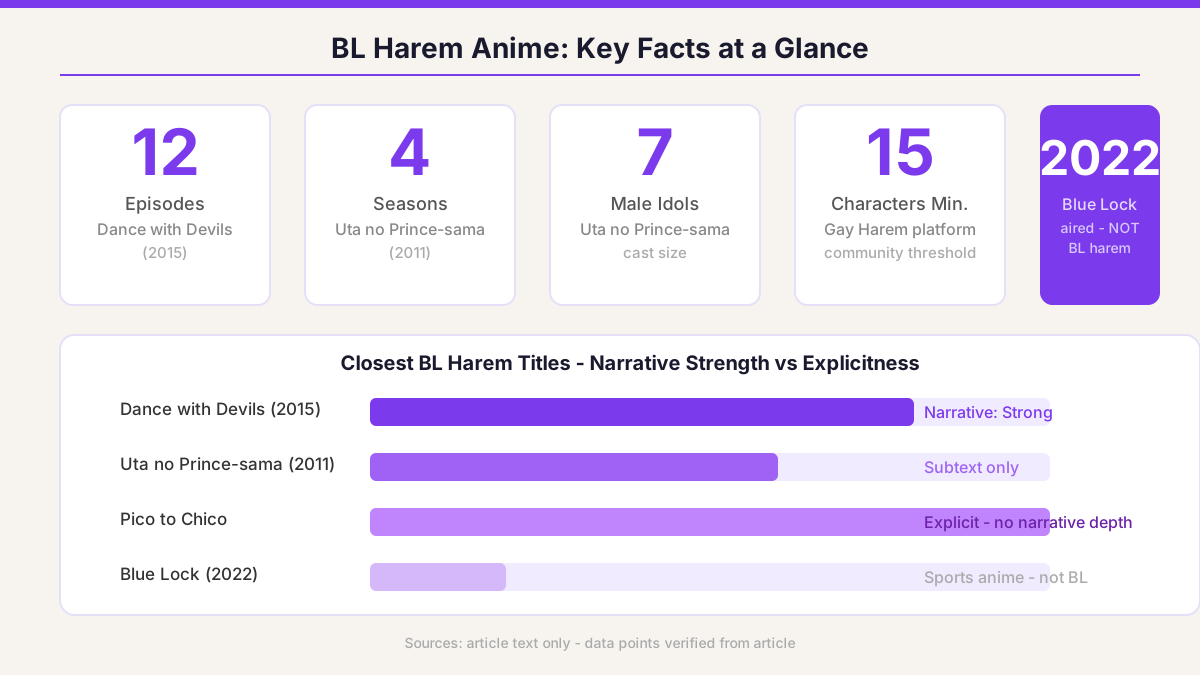
Search "BL harem anime" on MyAnimeList and the top community-built lists pull in titles like Blue Lock (2022) and JoJo's Bizarre Adventure Part 5 - neither of which is BL harem by any strict reading. What you are actually seeing is fans curating "shows with attractive male casts" rather than genuine romantic harem structures. Worth knowing before you build a watchlist from those lists and feel cheated by episode three.
The Shows That Come Closest to BL Harem
Dance with Devils (2015) is the most defensible entry. It centres on a male-dominated cast of devil characters competing for the attention of one protagonist, and the romantic tension between those male characters is a deliberate part of the show's appeal. It aired with an otome-game framing, but the aesthetic and emotional mechanics of a BL harem are present throughout its 12 episodes. Art quality is above average for its budget year, and the music direction is genuinely good.
Pico to Chico sits at the other end of the content spectrum entirely - explicit, short-form, and produced specifically for an adult male gay audience. It does not deliver narrative depth, but it delivers the harem structure without ambiguity. Not available on Crunchyroll. Avoid expecting anything beyond its stated function.
Uta no Prince-sama (2011) is reverse harem aimed at women, but its male cast is so densely homoerotic in fan reception that it earns a mention here. Seven male idols, one protagonist, recurring romantic tension between the male characters themselves. The show ran for four seasons - a signal that it found a sustained audience. If you can tolerate the otome framing, the BL subtext is consistent and the animation holds up.
For readers who want to understand what a gay harem actually means as a concept beyond anime, the mechanics differ significantly between animated fiction and interactive platforms.
Where Gamified BL Harem Actually Lives
Anime has not cracked this genre cleanly. Interactive content has. Gay Harem, the platform this site covers, structures its experience around exactly the harem-building fantasy that BL anime fans are searching for: a male protagonist acquiring a roster of male characters through progression and interaction. The platform requires 15 characters in your harem before you reach full community recognition - that number is not arbitrary, it mirrors the saturation point most harem narrative arcs hit before the story is forced to resolve.
The club system adds a layer that no anime replicates: shared experiences with other players in real time. That is a structural advantage over passive viewing. Whether that appeals to you depends on whether you want to watch a harem story or participate in one.
Spending time auditing how cam and interactive platforms handle their internal economies is instructive. What actually happens on most platforms is that headline engagement metrics look generous until you read the fine print on progression thresholds and access gates. The mechanics of those systems are designed to retain engagement, not to immediately reward it - a 15-character minimum before community recognition is a classic example of that pattern. Check the progression requirements on day one, not after you have invested 30 hours. That is solid practice on any platform.
For more on how the platform itself works, see the Gay Harem review which covers the progression system in detail.
How These Shows Compare on Key Criteria
If you are building a watchlist, here is the honest breakdown. Dance with Devils has the strongest narrative structure and is the most accessible entry point - 12 episodes, complete story arc, legally available via streaming in the UK. Uta no Prince-sama runs longer (four seasons) and rewards patience, but its otome framing can feel alienating if you came for explicit BL content rather than subtext. Pico to Chico delivers the BL harem premise most directly but offers nothing beyond that premise.
Blue Lock (2022) appears on community BL harem lists constantly and deserves a direct verdict: it is not BL, it is sports anime with intense male rivalry. The homoerotic reading is fan-driven. If that is enough for you, fine - but go in knowing what it is. One Punch Man and Bungou Stray Dogs appear on the same lists for similar reasons. Strong male ensemble casts, zero romantic BL structure.
For viewers in the UK looking at what is legally available on Crunchyroll specifically, the answer is limited. Crunchyroll carries some BL-adjacent titles but nothing that qualifies as explicit BL harem. The spicier end of the genre - anything beyond subtext - sits on dedicated adult platforms or requires importing physical media. That is a licensing gap, not a content gap. The anime exists; the UK distribution is the bottleneck.
If the top gay anime overview is what you need first, that page covers the broader category before narrowing to harem structures.
What Actually Makes a BL Harem Work
The genre lives or dies on one mechanic: does each male character in the harem feel distinct enough to generate genuine preference in the audience? In standard harem anime this is handled through archetype differentiation - the childhood friend, the rival, the mysterious transfer student. BL harem needs the same architecture but applied to male-male romantic dynamics, which requires writers comfortable with those dynamics rather than writers adapting a template.
That is why most successful BL harem content right now is in manga and games rather than anime. The production cost of anime means studios gravitate toward proven commercial formulas. BL harem has not yet generated the box-office evidence that would push a major studio to greenlight a genuine 12-episode BL harem series with a real budget. The genre is not niche because the audience is small - Reddit threads on this topic run to hundreds of comments. It is niche because the production pipeline has not caught up.
Problematic, but not permanent. The growth of streaming platforms with global subscriber bases is shifting that calculation. If a show performs in 40 countries simultaneously, the economics of a BL harem adaptation change. Watch the 2024 to 2026 licensing announcements from Crunchyroll and HiDive for movement in this space.
Comments
No comments yet.
Leave a comment
Your email will not be shown. Comments are reviewed before they appear.