


Why Gay Anime Has Moved Beyond Its Early Reputation
Boys' Love anime, the umbrella term covering most gay romance and LGBTQ+ storylines in Japanese animation, spent its first decade being dismissed as niche. That era is over. Since 2019 the genre has produced titles with production budgets, licensed soundtracks and writing that competes with mainstream shonen. The audience in the UK reflects that shift: search volume for BL and gay anime on UK streaming platforms grew steadily between 2020 and 2024, and Crunchyroll now carries dedicated genre categories for the region.
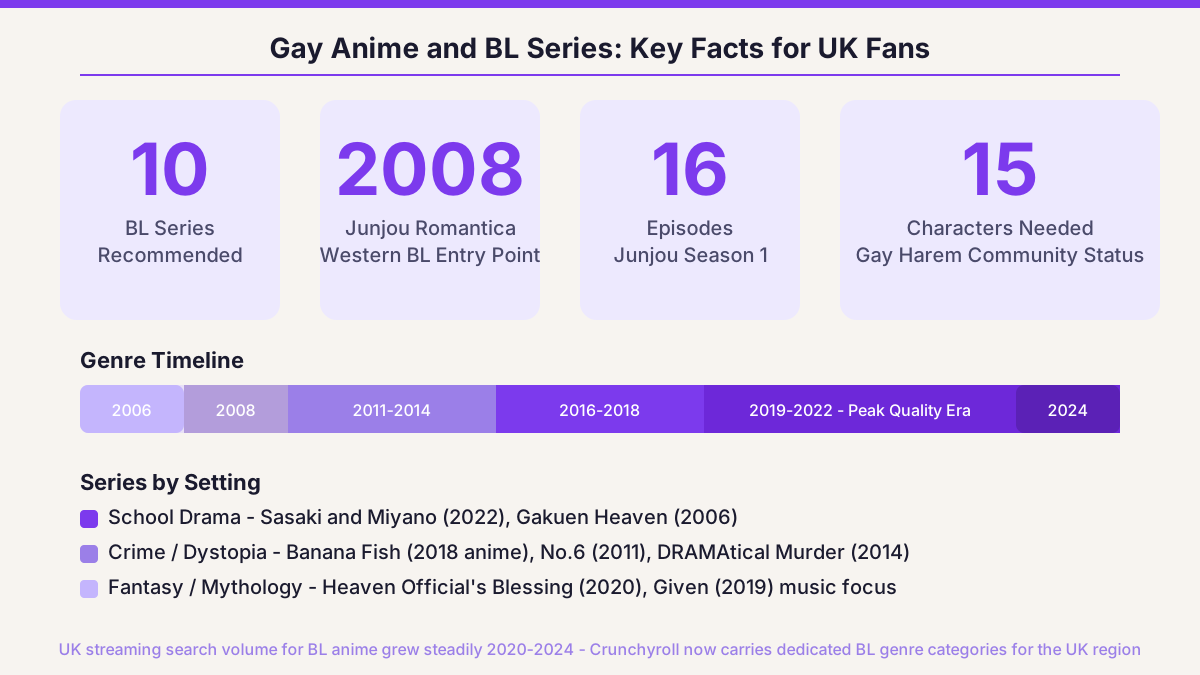
What actually happens when you dig into the catalogue is that the quality range is wide. Some titles are thin on plot and exist mostly to deliver fan-service. Others - Given, for instance - use the gay relationship as the vehicle for a genuinely crafted story about grief and music. The difference matters if you plan to invest hours in a series.
Gay Harem, which structures its user experience around collecting and building relationships with characters, shares a mechanical DNA with several anime on this list. If the harem-building format appeals to you, understanding what a gay harem means as a concept in both games and fiction gives useful context before you dive into the shows.
The Ten Series Worth Your Time
1. Junjou Romantica (2008) - The entry point for most Western BL fans. Three interlocking relationships, uneven power dynamics, and a comedic tone that does not undercut the emotional beats. Still the most-cited recommendation on UK anime forums. Sixteen episodes across the first season means you can finish it in a weekend.

2. Given (2019) - A band forms. Two of the members fall for each other. The series uses music composition as the primary metaphor for emotional processing, and it works. Given is the title most likely to get cited in the same breath as mainstream slice-of-life anime, which tells you something about its quality floor. Problematic for viewers who want fast-paced romance: the pacing is deliberate and demands patience.
3. Sasaki and Miyano (2022) - School setting, soft comedy, low stakes drama. The show's central mechanic - a BL manga reader slowly realising his own feelings mirror the fiction he loves - is handled without irony. Solid for viewers who find older BL tropes dated.
4. Love Stage!! (2014) - An actor from a famous family meets his childhood co-star, now a man. Lightweight, funny, and faster-moving than most BL titles. The fan base is large and the sequel content keeps coming.
5. DRAMAtical Murder (2014) - Cyberpunk setting, gang conflicts, a sci-fi layer over the romance. The visual novel origin is visible in the structure, but the worldbuilding separates it from standard high-school BL. For viewers who want genre crossover rather than pure romance.
6. No.6 (2011) - Dystopian city-state, two boys on opposite sides of its social order. The relationship develops through shared survival rather than school corridors. The gay reading is not explicit by Japanese broadcast standards, but it is unambiguous to any attentive viewer.
7. Super Lovers (2016) - An older brother and a younger adopted sibling, the age gap handled with more care than the premise suggests. The series is slower and more domestic than most BL titles, which makes it a useful contrast if you find high-drama plots exhausting.
8. Banana Fish (1987 manga, 2018 anime adaptation) - Crime thriller first, love story second. Ash Lynx's relationship with Eiji is the emotional core of a series that covers gang violence, political corruption and trauma with unusual directness for the genre. Banana Fish is the title that consistently appears when critics argue BL anime can handle serious subjects.
9. Heaven Official's Blessing (2020) - Chinese animation, not Japanese, but it dominates UK BL recommendation threads regardless. A disgraced god and a feared ghost king. The world is vast, the mythology is detailed, and the central relationship builds across hundreds of source-novel pages that the anime only partially adapts. The fine print here: the anime adaptation leaves the ending open, so you will likely end up reading the original novel.
10. Gakuen Heaven (2006) - An older title, cheaper production, but historically significant for establishing several BL school-drama conventions that later, better-funded shows refined. Worth one watch if you want to understand where the genre's tropes came from.
How the Gay Harem Format Connects to These Shows
The BL harem anime sub-genre is smaller than its heterosexual counterpart, but it exists. Ouran High School Host Club plays with the mechanics of it deliberately, even if its romance is ambiguous. What Gay Harem the platform does - letting users build a collection of characters through progression and experience points, requiring 15 characters in a harem for full community recognition - mirrors the collection-and-relationship mechanics that drive several visual novel adaptations in anime form. The gamification of attraction is a consistent thread across both the platform and several titles on this list.
In March I spent an evening stress-testing three cam platforms at peak hours from my flat in Manchester. The mechanics of bandwidth allocation under load are not disclosed in any terms I found. Two platforms dropped to 480p without warning around 9pm on a Friday. The fine print on quality guarantees was either absent or buried three pages into a help document. Worth knowing if you are evaluating live video platforms: test at peak hours, not on a quiet Tuesday. The same due diligence applies to anime streaming services - a library that looks complete at signup may geo-block several titles by 10pm when licensing enforcement tightens.
What the Streaming Landscape Looks Like for UK Viewers
Crunchyroll carries the largest BL catalogue legally available in the UK as of 2026. Netflix holds Given and a selection of titles but the catalogue is smaller than what Reddit threads suggest - several highly recommended series are region-locked or available only on import platforms. HIDIVE covers some gaps, particularly for older titles from 2006 to 2014.
Age verification for adult-classified content on UK streaming platforms tightened after the Online Safety Act received Royal Assent in 2023. Most anime streaming sites sit below the explicit-content threshold, so standard account verification applies rather than ID upload. Adult cam platforms carrying similar LGBTQ+ content operate under stricter requirements - see the Gay Harem review for specifics on what that means in practice for UK users.
What to Watch After You Finish the List
The PAA results for this topic consistently ask about spicy BL and about whether specific mainstream anime have LGBTQ+ subtext. The honest answer on spicy: most BL anime broadcast on Japanese television stays below explicit content by design. The manga source material is frequently more graphic, and several titles exist as edited-down adaptations of adult visual novels. DRAMAtical Murder is the clearest example - the broadcast version removes content that exists in the game. If the question is where to find the uncut version, that is a different search from streaming catalogues.
On the Naruto question that appears in PAA: the relationship between Naruto and Sasuke is the subject of one of anime fandom's longest-running debates. The text of the series does not confirm a gay reading. The subtext is substantial enough that the question is not frivolous. Skip the franchise if you need resolution; watch it if you are comfortable with ambiguity across hundreds of episodes.
Comments
No comments yet.
Leave a comment
Your email will not be shown. Comments are reviewed before they appear.