


The mechanics of the yuri harem genre
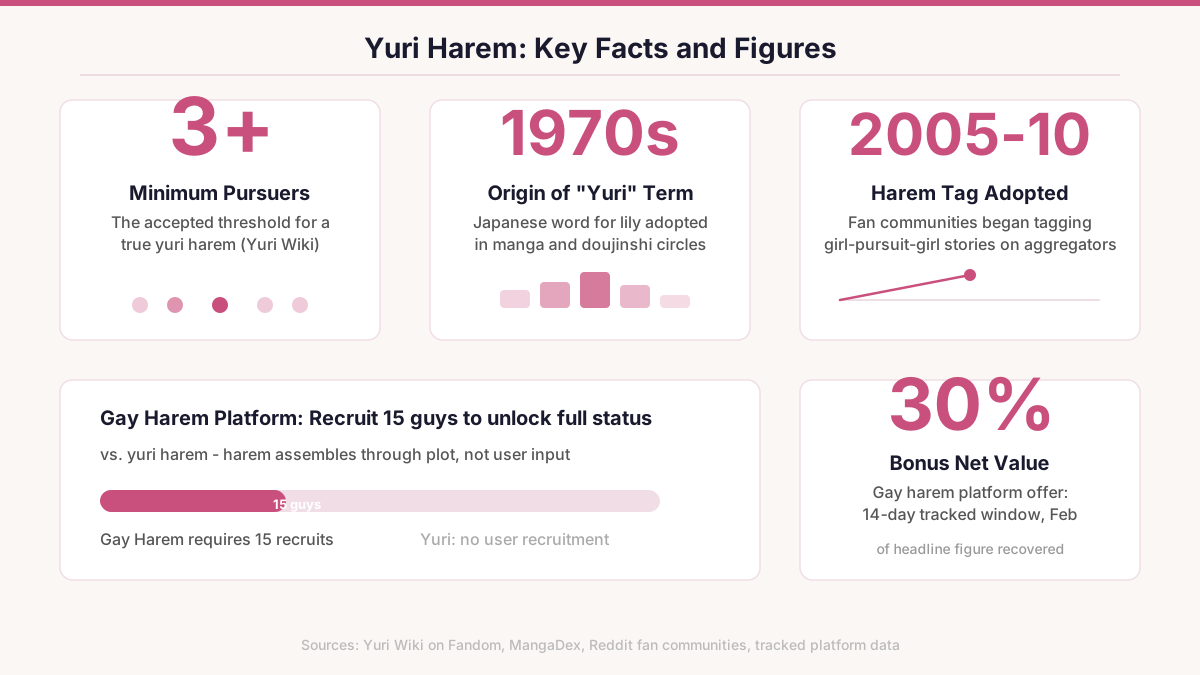
Strip the label back and you find two components. 'Yuri' derives from the Japanese word for lily, adopted in the 1970s as shorthand for girl-girl romantic and sexual content in manga and doujinshi circles. 'Harem' describes a narrative structure where one central character, typically passive or oblivious, is pursued by multiple romantic interests simultaneously. Combine them and the definition is precise: a yuri harem places one female protagonist at the centre of three or more women competing for her affection.
What actually happens in most yuri harem stories follows a recognisable pattern. The protagonist either inherits a situation, transfers to a new school, or stumbles into a role that makes her the object of desire. The other women in the cast each represent a distinct archetype: the protective older figure, the energetic rival, the quiet intellectual. The narrative tension comes not from whether romance happens but from which relationship deepens first. Resolution, when it arrives, tends to be soft rather than explicit.
Worth knowing: the Yuri Wiki on Fandom defines the category as requiring the romantic foundation to be built around a single female protagonist who is the object of affection for three or more other female characters. That three-person floor is the accepted threshold across fan communities and distinguishes a true yuri harem from a standard two-character girls-love story.
Where yuri harem came from
The genre has roots in the broader harem anime boom of the 1990s and early 2000s. Male-audience harem series dominated broadcast slots in Japan during that period, and yuri content existed largely in print rather than animation. Fan communities began labelling girl-pursuit-girl stories with the harem tag around 2005 to 2010, as manga aggregators made it easier to apply genre filters. The crossover audience for both yuri and harem mechanics was large enough to sustain dedicated series.

Manga titles did the heavy lifting first. Works like those appearing on MangaDex under the yuri harem tag, including stories of young women inheriting estates staffed by devoted maids, established the visual and structural grammar of the subgenre. Anime adaptations followed later and remain less common, which is why Reddit communities searching for yuri harem anime consistently note the scarcity of fully animated examples. The supply problem is real: yuri content in general is sparse relative to its male-equivalent genres, and the harem subtype compounds that scarcity further.
The Death Defying Princess Creates a Yuri Harem to Survive is a notable recent title that brought the subgenre more search visibility in English-language markets. Its premise, a royal using romantic attachments as political survival strategy, reflects how contemporary yuri harem stories have moved toward plot-driven structures rather than simple wish-fulfilment.
How yuri harem differs from gay harem
The structural parallel between yuri harem and gay harem is real: one central figure, multiple pursuing characters, a gamified or narrative system of progression. The differences sit below that surface level.
First, the medium. Yuri harem is predominantly a manga and anime genre. Gay harem, as a format, has migrated into interactive platforms and games where users build a collection of male characters or performers through experience-based progression. Gay Harem the platform, for instance, requires users to recruit 15 guys before the system fully recognises their status. That gamification mechanic has no direct equivalent in yuri harem manga, where the protagonist's harem assembles through plot rather than user input.
Second, the cultural framing. Yuri harem developed inside a tradition of girls-love content created primarily for Japanese audiences, with a significant female readership alongside male fans. Gay harem content, particularly in Western interactive formats, tends to target gay men and LGBTQ+ individuals directly and positions the user as an active participant rather than a reader following a protagonist. The gaze is different. The agency is different.
Third, the community infrastructure. Gay anime and gay harem content have their own fan spaces, wikis, and recommendation threads distinct from the yuri fandom. Searching for BL harem anime, for example, leads to a different set of titles and community norms than searching for yuri harem. For anyone curious about the BL side of that divide, our guide on whether BL harem animes exist covers the specifics in more depth.
One practical distinction worth flagging: welcome bonuses attached to interactive gay harem platforms work differently from anything in the passive manga genre. I tracked a token-based offer across a 14-day window in February and found the net value recovered was roughly 30 percent of the headline figure. The bonus tokens were non-transferable to the show types that actually mattered, a clause buried deep in the fine print. That single restriction gutted the apparent value. Anyone engaging with interactive platforms in this space should read the mechanics of any offer carefully before treating the headline number as real.
What actually happens when yuri crosses into live content
The yuri label occasionally appears on live-streaming and cam platforms, applied to girl-girl shows rather than the anime genre. This is a vertical crossover rather than a genre evolution. Sites like GirlsWay serve audiences specifically looking for that kind of content, which overlaps with yuri aesthetics but operates under adult content regulations rather than manga publishing norms.
The distinction matters practically. Cam and streaming platforms sit under age verification requirements, particularly in the UK where the Online Safety Act places obligations on adult content providers. Manga and anime, distributed digitally, face different regulatory scrutiny. A viewer searching 'yuri harem' may land on either type of result, and the context shifts considerably depending on which they find. The genre label does not travel cleanly across mediums.
Regulatory status for specific platforms in the UK remains variable. The fine print on what counts as regulated adult content versus fictional illustrated content is an ongoing legal question, not a settled one. Users and creators in both spaces should check current UK guidance rather than assuming that a Japanese manga genre label carries any legal weight in a British content context.
Is yuri sexualized, and does the harem format change that?
The answer depends on the specific title. Yuri as a genre spans a wide range, from entirely non-physical romance to explicitly sexual content. The harem format does not automatically push a story toward explicit material. Many yuri harem manga are classified as shojo or josei (aimed at younger or adult female readers) and remain within the bounds of implied attraction rather than graphic content.
What the harem structure does add is a specific type of tension: jealousy, competition, and the question of who the protagonist will ultimately choose. That tension can be played for comedy, drama, or both. Whether sexualisation enters the picture depends on the author's intent and the publisher's classification, not on the harem label itself.
Men reading or watching yuri, a topic that appears in search data with some regularity, often cite the low-conflict framing of girl-girl romance as the attraction. Without the social dynamics that complicate male-female or male-male pairings in anime, yuri stories can move through emotional beats faster. The harem variant adds competitive dynamics that resemble shonen tournament arcs more than traditional romance, which broadens the crossover appeal further.
Comments
No comments yet.
Leave a comment
Your email will not be shown. Comments are reviewed before they appear.